

Earthset from the lunar side .
Menu of the day:
Markets: risk likes proof
The article: seats become meters
Shot: defense, rules, and factories
Startup Lesson: price the job
Doggy Bag: hacker hotels and industrial AI
What to watch: credits and credibility
Market pulse
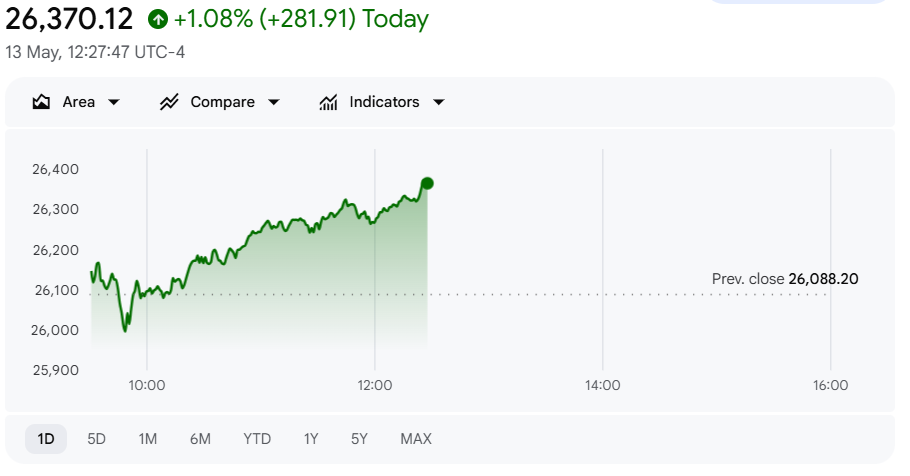
The market is still trying to have a risk-on week without looking too irresponsible in front of the macro adults. U.S. stocks paused after brushing against records, with tech doing the usual emotional work: semiconductors bounced, AI names stayed crowded, and oil kept reminding everyone that inflation is not only a spreadsheet problem.
The useful read is not that investors suddenly hate growth. They very much do not. The read is that the market is getting sharper about what kind of growth deserves the benefit of the doubt. AI infrastructure, defense technology, security, and software tied to hard budgets still get attention. Generic software with a vague AI costume gets a smaller plate.
For founders, that is the weather: capital is open, but it wants the line item. If the product saves time, show the time. If it replaces services, show the services budget. If it uses expensive compute, explain who pays for the electricity wearing a hoodie.
The article: The seat is getting expensive

Software pricing used to be wonderfully boring. Count the users. Multiply by a monthly number. Add enterprise support if the procurement team needs to feel seen. Everyone pretends the spreadsheet is strategy. Life goes on.
AI is ruining that peaceful little arrangement.
The seat made sense when software mostly gave humans access to tools. A user opened the CRM, edited the doc, clicked the dashboard, annoyed a colleague in a comment thread, and then went home. The vendor charged for access because access was the product. The marginal cost of another active user was low enough that everyone could focus on expansion revenue, customer success decks, and the quiet art of making plan names more confusing than necessary.
Agents change the unit. The customer is not only buying access anymore. They are buying work: calls handled, tickets resolved, code reviewed, documents processed, research completed, workflows triggered, maybe even decisions recommended. That sounds better than seats until the vendor remembers that work has cost. Tokens cost money. Inference costs money. Agent loops cost money. Tool calls, context windows, review steps, memory, logging, and audit trails all cost money. The robot may not need health insurance, but it does send a bill.
This is why software pricing is drifting toward hybrid models, AI credits, usage meters, and outcome language. The industry is trying to answer a simple but uncomfortable question:when software does part of the labor, should the price look more like software, services, infrastructure, or a tiny consulting firm trapped inside a product UI?
In practice, nobody has a clean answer yet. Hybrid pricing is spreading because it lets companies keep the comfort blanket of subscriptions while charging for the expensive parts on top. AI credits are spreading because they turn messy compute consumption into something finance teams can track. Outcome pricing keeps appearing because it is a beautiful sales sentence: pay us when the thing works. Very elegant. Also very hard once the customer asks who gets credit for the outcome, whether the outcome is measurable, and why the invoice looks like a philosophical argument.
The bigger companies are moving first because they have the most to protect. GitHub is shifting Copilot to usage-based AI Credits from June 1. Salesforce has been experimenting with more than one way to price Agentforce. HubSpot, Anthropic, SAP, OpenAI, Figma, Canva, Clay, and others are all part of the same broader pricing rewrite. This is not a startup curiosity anymore. It is what happens when the cost structure of the product changes underneath the go-to-market motion.
Quick reminder: the old SaaS dream was beautiful because gross margins were beautiful. Build once, sell many times, watch marginal cost stay politely small. AI makes that less automatic. A product that uses heavy inference may still be high-margin compared with services, but it is not always old-school SaaS-margin pretty. If the customer uses more, the vendor pays more. If the agent gets smarter by doing longer tasks, the bill may grow with the value. Useful, yes. Awkward for simple pricing pages, also yes.
That creates a founder problem and an investor problem.
The founder problem is packaging. If you price only by tokens, you sound like a cloud bill and invite the buyer to optimize you down. If you price only by seats, your power users may quietly eat the margin. If you price by outcome, you need attribution, consistency, measurability, and predictability. If you price by flat fee, you may be subsidizing your most expensive customers while the quiet ones wonder why they are paying for everyone else’s agent enthusiasm.
The investor problem is quality of revenue. A company that says AI increased usage may be telling you demand is real. It may also be telling you gross margin is about to put on a small helmet. The better question is whether usage expands with customer value, whether the vendor has pricing power, and whether the product can reach budgets outside the normal software line. If AI only cannibalizes existing SaaS spend, the market gets a feature cycle. If AI taps services, headcount, compliance, support, or revenue operations budgets, the market gets a bigger prize.
That is where the real story sits. The next great AI software companies may not win because they have the cleverest meter. They may win because they know which budget they are replacing. Support labor. Compliance review. SDR research. Code review. Data cleaning. Customer operations. The closer the product gets to a real business job, the easier it becomes to charge for value instead of access.
This is also why the seat will not disappear completely. Enterprises like predictability. Procurement people enjoy control in the same way toddlers enjoy repeating the same book 41 times. A monthly subscription gives them a box. Usage pricing gives them a moving object. The likely future is not one pure model. It is a layered mess: platform fee, included credits, overage, premium workflows, maybe outcome clauses for the brave or the heavily caffeinated.
For founders, the practical landing is simple: price the job, not the magic. What work does the product do? What budget does that work come from? What cost does the customer avoid? What risk does the customer reduce? What happens when usage grows? If those answers are vague, the pricing model is probably not the first problem. The positioning is.
Bottom line
AI is not killing SaaS pricing. It is making software admit what it actually does. Access was easy to price. Work is harder. Harder usually means messier, but also more valuable if you can prove the job.
Shot: Anduril makes defense tech look like late-stage software

Anduril raised $5 billion at a $61 billion valuation after more than doubling 2025 revenue to $2.2 billion. That is not a normal defense-company sentence. It is venture capital applying software appetite to drones, sensors, command systems, and manufacturing capacity.
The interesting part is not only the valuation. It is the category shift. Defense technology is becoming a place where private capital believes speed, software, autonomy, and manufacturing can compound together. The catch is that weapons are not dashboards. Scale still has to pass through factories, qualification, procurement, politics, and the deeply unromantic business of making hardware work when the consequences are real.
Shot: Europe gives AI compliance more runway

Europe’s AI rulebook got a timing reset. High-risk AI obligations for areas such as biometrics, critical infrastructure, education, employment, migration, and border control are now set to apply from December 2027, while certain product-embedded systems move to August 2028.
That does not mean regulation vanished. It means the compliance clock became more legible. For AI founders selling into Europe, the lesson is not to ignore the rulebook. It is to use the extra time to build governance into the product instead of duct-taping it onto the sales deck later. Compliance is annoying. Retrofitted compliance is expensive annoying.
Shot: Europe remembers it has factories.

Industrial AI is having a better European moment than the consumer-AI discourse sometimes allows. Manufacturing, energy systems, robotics, scientific discovery, climate infrastructure, and advanced engineering are exactly the kinds of domains where Europe still has depth.
That matters because the next AI wave may be less about thin wrappers and more about systems that touch physical operations. Proprietary data, domain expertise, deployment reliability, and unit economics become harder to fake when the product has to work near machines, grids, materials, or regulated workflows. The demo gets attention. The plant manager gets veto power.
Startup Lesson: Price the job
If you are building an AI product, do not start pricing with the model menu. Start with the customer's job.

A founder can spend two weeks debating credits, seats, usage tiers, and outcome fees and still miss the real question: what does the buyer believe they are buying? If they think they are buying software access, seats may work. If they think they are buying completed work, a pure seat model may feel disconnected from value. If they think they are buying risk reduction, the price needs to attach to confidence, speed, auditability, or avoided cost.
The clean exercise is this: write the sentence, “We replace or improve _____.” If the blank says “productivity,” try again. If it says “level-one support tickets under these conditions,” “regulatory review time for this workflow,” or “qualified research before an outbound sequence,” the pricing conversation has somewhere to stand. The model follows the job. Otherwise, the pricing page becomes a mood board with numbers.
Doggy Bag

A hacker hotel in Helsinki is trying to become part YC, part Stanford, part Bell Labs for ambitious young builders. It charges 0% equity, covers living costs, and leans hard into intensity. The lesson is not that every founder needs a monastery with better Wi-Fi. The lesson is that Europe is still experimenting with founder formation, and the best experiments may look slightly unreasonable before they look obvious.
AI discovery is becoming shelf space. If customers ask an assistant which product to buy, the winning brand may be the one that appears in the answer, not the one that ranked nicely on a search page. SEO was already unpleasant. Agent visibility may become the version that wears a suit and asks for structured metadata.
The private-market appetite for late-stage winners remains very alive. Anduril is the loud example, but the broader signal is simpler: investors still want scarce exposure to companies that look like category-defining assets. Scarcity creates appetite. Appetite creates price. Price occasionally starts doing performance art.
What to watch:

Watch AI pricing changes into June. GitHub’s Copilot shift will make usage-based AI credits more visible to normal software buyers.
Watch Anduril’s manufacturing milestones. The valuation story depends less on narrative now and more on whether autonomous defense systems scale reliably.
Watch Europe’s AI Act implementation. The delayed timeline helps founders, but buyers will still ask governance questions early.
Watch industrial AI in Europe. The strongest companies may come from deep domain wedges, not consumer-style wrappers.
Watch services budgets. If AI software starts replacing actual work instead of just adding features, pricing power gets much more interesting.