
Morning. The market is now trying to solve the least romantic part of the AI agent dream: what happens when the little digital worker wants to spend money. Apparently the answer is not “let it vibe through checkout.” It is bank charters, card-network rules, stablecoin rails, spending limits, audit trails, dispute processes, and someone in compliance asking whether the robot is allowed to buy copper futures before lunch.
Today is mostly about AI leaving the browser tab and meeting the payments department. The future is still automated. It just needs a receipt.
Menu of the day
Markets: AI memory eats the tape
The article: agents need adult supervision
Shot: Europe sells health, Claude finds Milan, SpaceX gets the backbone
Startup Lesson: permissions are product
Doggy Bag: honey, rings, and machine wallets What to watch: who controls the checkout
Market pulse
Quick note: market data below reflects the latest available session before drafting.
Markets: U.S. equities came back from the holiday with the same strange confidence: oil is still tied to Iran headlines, rates are still not exactly relaxed, and yet the S&P 500 and Nasdaq both set records. The tape is not saying risk disappeared. It is saying investors are still willing to buy the pieces of the AI cycle where demand looks contractual, physical, or supply-constrained.
Movers: Micron briefly joined the trillion-dollar club after another AI-memory surge, which is a useful little market poem. The glamour layer still gets the headlines, but the memory layer is starting to get the multiple. Meanwhile Brent has been moving around the U.S.-Iran negotiation tape, with traders trying to price whether the Strait of Hormuz gets safer before inflation gets uglier. Translation for founders: capital is not scared of big stories. It is scared of stories without a toll booth.

The article
Fintech - Agentic Commerce - Money gets a license
The first version of the AI agent story was charmingly naive. An agent would book your trip, buy your groceries, compare suppliers, negotiate with a SaaS vendor, reconcile your invoice, and generally turn the internet into a personal assistant with a corporate card.
Nice idea. Tiny problem: payments are not prompts.

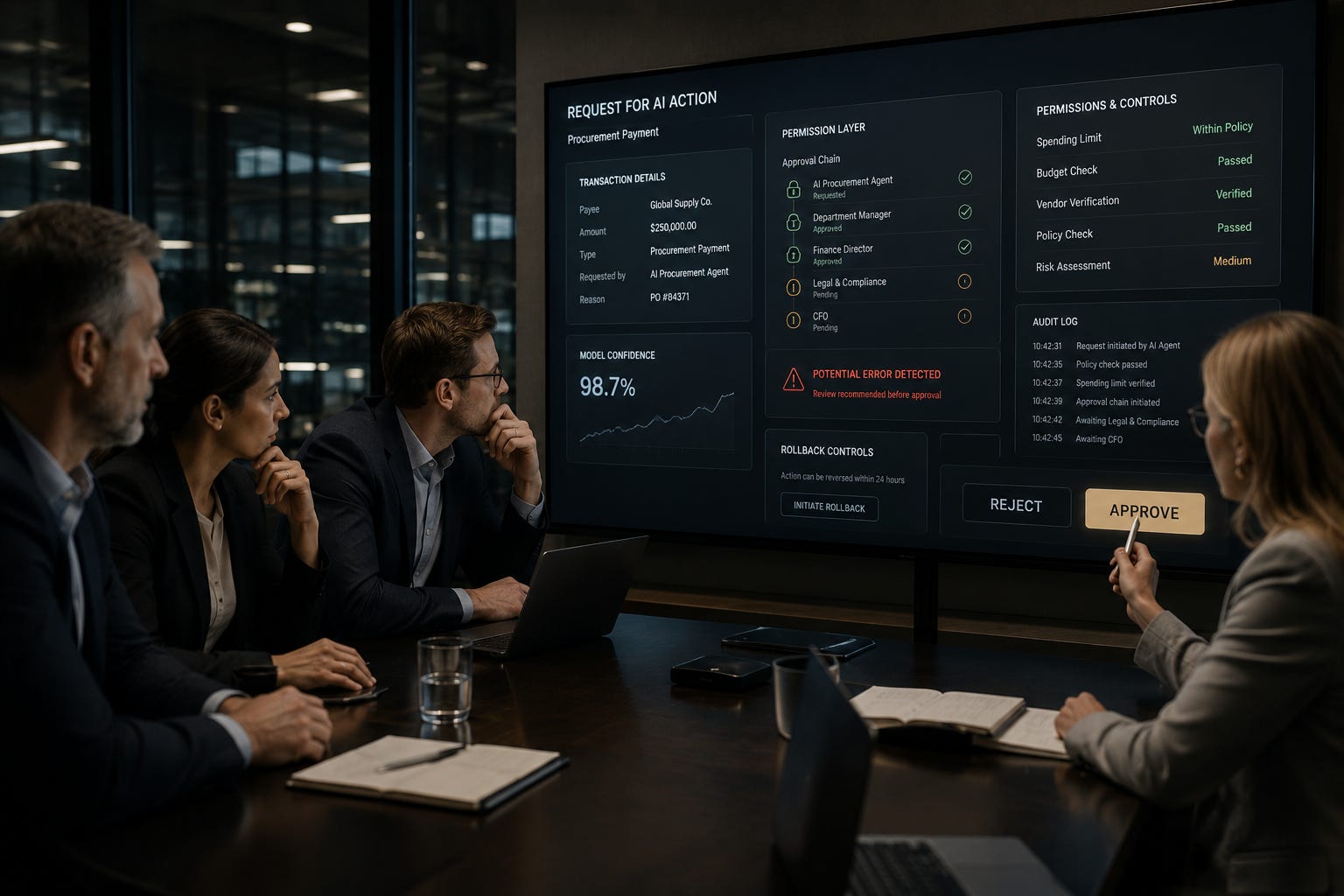
When software starts moving money, the questions change. Who authorized the transaction? What was the spending limit? Which merchant was allowed? What happens if the agent chooses the wrong item, gets manipulated by a webpage, buys from a sanctioned counterparty, or optimizes for the cheapest supplier and accidentally creates a procurement scandal with a nice UI?
That is why the current agentic-commerce wave is less about cute demos and more about financial plumbing. Catena Labs, founded by Circle co-founder Sean Neville, raised a $30 million Series A and is applying for a national trust bank charter. The pitch is not just “agents will spend money.” The pitch is that autonomous software needs regulated accounts, identity, governance, risk controls, and a financial institution designed for non-human economic actors.
Quick reminder: a bank charter is a very different kind of startup signal from a waitlist. It says the category is trying to move from experimental workflow to regulated infrastructure. Investors are no longer only funding the brain. They are funding the permission system around the brain.
The same pattern is showing up elsewhere. AEON raised pre-seed capital for an agent settlement layer. AWS has been previewing agent payment infrastructure with Coinbase and Stripe. Visa and Mastercard are both pushing agentic commerce programs built around trusted agents, tokenization, user controls, and merchant readiness. PayPal is preparing merchants to accept payments from AI shopping assistants across major platforms.
In practice: everyone is trying to answer the same boring question before it becomes expensive. If agents can discover, compare, choose, and act, then checkout becomes a control layer. The winner may not be the agent with the cleverest product recommendation. It may be the network that merchants trust, banks can audit, regulators can understand, and users can shut off when the agent decides that “budget-friendly” means a bulk order of ergonomic chairs.
The catch: agentic money is not one market. Consumer shopping, B2B procurement, API micropayments, stablecoin settlement, treasury workflows, cross-border payouts, and DeFi derivatives all want different rails. Some flows need card protections. Some need bank-grade custody. Some need programmable stablecoins. Some just need a clean way to prove that the human meant to delegate the action.
This matters for founders because the interface is shifting. Today a merchant optimizes for search, social, marketplaces, and a human who can click checkout. Tomorrow, part of that demand may arrive through an agent that wants structured product data, clear return rules, available inventory, machine-readable pricing, merchant reputation, and a payment path it is allowed to use. If your company cannot be understood, trusted, and paid by software, you may become invisible in the transaction flow even if your website looks lovely to humans.
For investors, the useful question is where value capture sits. The agent app may own the customer relationship. The payment network may own authorization. The wallet may own identity. The merchant platform may own inventory. The stablecoin layer may own settlement. The compliance provider may own risk scoring. That is a lot of hands near the same transaction, which means the cap table version of the story will be messier than the demo.
Zoom out: AI agents are not becoming important because they can click buttons. They are becoming important because they can turn intent into economic action. The minute that happens, the market stops asking only “can it reason?” and starts asking “can it be trusted with money?”
That is less magical, but more useful. Software that spends needs adult supervision. The companies that make that supervision invisible may end up owning the most valuable part of the agent stack.
Shot
Oura tests the public-market wrist
Oura has confidentially filed for a U.S. IPO after last year’s $11 billion valuation, giving Europe another consumer-health company trying to cross from beloved device into public-market discipline. The founder lesson is simple: subscription hardware can look beautiful when retention, data, and brand all point in the same direction. Public investors will still ask whether the ring is a platform or a very elegant sensor business with upgrade-cycle anxiety.
Claude gets a Milan address
Anthropic is opening a Milan office as Europe keeps becoming a serious enterprise AI market, not just a regulation meme. The company has previously said EMEA run-rate revenue grew more than 9x over a year, and the office map now looks like a commercial strategy: London, Dublin, Zurich, Paris, Munich, Milan. The read-through is that governance-heavy markets can still buy frontier AI when the vendor shows up with local relationships and compliance language.
SpaceX becomes infrastructure again
The U.S. Space Force awarded SpaceX a $2.29 billion contract for the Space Data Network Backbone, a low-Earth-orbit communications layer meant to connect military sensors and weapons platforms. It is another reminder that the most valuable space company in the world is not only selling rockets. It is selling strategic connectivity. The private-market premium is partly about launch, partly about networks, and partly about becoming difficult for the state to route around.
ABM gets less fluffy
Modern account-based marketing is quietly becoming a data-engineering job. The useful version is not “personalized outreach with AI sprinkles.” It is TAM mapping, account enrichment, CRM hygiene, qualification prompts, stakeholder routing, and a system that knows which accounts are worth human attention. B2B founders should notice the pattern: AI makes generic outbound cheaper, which makes precise context more valuable.
Startup Lesson
Permissions are product

If your product lets a user, employee, customer, or agent take action, the permission layer is not admin plumbing. It is part of the product.
Who can approve? Who can spend? Who can override? What gets logged? What is reversible? What happens when the model is confident and wrong? These questions sound like enterprise procurement paperwork until one of them blocks the sale.
The strong founder move is to design permissions early enough that they become trust, not friction. Agentic products, fintech workflows, healthcare AI, procurement tools, and internal automation platforms all face the same test: the buyer does not only need the thing to work. The buyer needs to explain why it was allowed to work.
Doggy Bag
Fun fact: U.S. honey demand is getting weirdly intense, with restaurants putting honey on more menus while domestic production struggles. Apparently every market eventually becomes a supply-chain story, even breakfast.
The number: $2.29 billion. That is the Space Force contract awarded to SpaceX for the military space data network backbone. Not bad for a company many people still describe as a rocket launcher.
The quote: “Payments are not prompts.” It should be printed on the wall of every agentic-commerce startup before someone ships an autonomous refund flow.
Reco: before adding “agentic” to a product page, write the permission model in plain English. If the sentence sounds embarrassing, the feature is not ready.
And besides that
Visa and Mastercard are both trying to make agentic commerce feel safe enough for banks, merchants, and users before the first big dispute cycle arrives.
Stablecoin infrastructure keeps moving from crypto-native speculation toward cross-border payment plumbing, especially where banks want the benefits without handling every chain directly.
Oura’s IPO path will test whether consumer health data plus hardware can command software-style patience.
Anthropic’s European expansion is a reminder that AI regulation can slow vendors down, but it can also create demand for vendors that speak governance fluently.
Micron’s trillion-dollar moment makes memory look strategic, which is exactly what happens when the market realizes a boring layer became scarce.
SpaceX winning defense connectivity work keeps blurring the line between commercial space, national infrastructure, and strategic dependency.
What to watch
Watch whether agentic commerce produces real transaction volume or mostly infrastructure announcements before consumer behavior catches up.
Watch which payment layer wins trust first: card networks, bank-chartered agent accounts, stablecoin rails, or platform-native wallets.
Watch Oura’s public filing when it becomes visible; the unit economics will say more than the valuation headline.
Watch oil and rates around the Iran negotiation window because the market’s AI enthusiasm still lives inside a macro weather system.